 HESPER
HESPER
HESPER
A Cyclone Desander is an essential piece of equipment in the oil and gas industry. It plays a crucial role in removing sand and sediments from drilling fluids. This process ensures that the fluids remain efficient and effective. Removing unwanted particles prevents damage to pumps and other equipment downstream.
Understanding how a Cyclone Desander works can enhance operational efficiency. This device utilizes centrifugal force to separate solids from liquids. As the fluid enters the desander, it spirals down, creating a vortex. The heavier particles are forced outward, settling at the bottom. Such simplicity in design is key to its effectiveness.
Yet, challenges remain. Proper maintenance is crucial to keep a Cyclone Desander functioning optimally. Clogging can occur if sediment is not adequately managed. Operators must be vigilant and monitor performance regularly. This vigilance ensures reliability and longevity, vital in high-stakes environments like oil drilling.
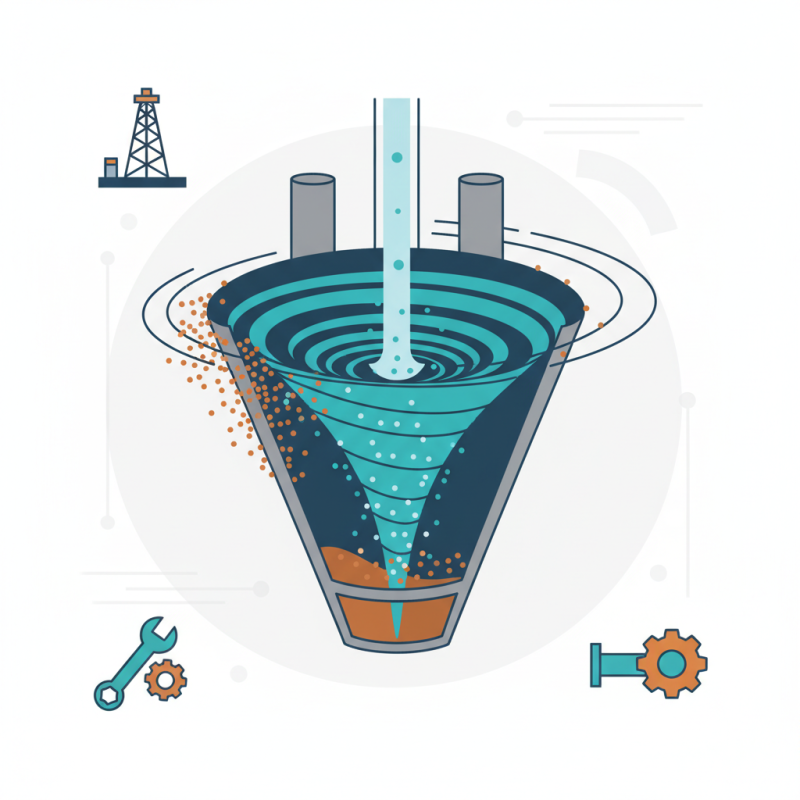
A cyclone desander is an essential equipment used in separation processes, particularly in the oil and gas industry. Its primary function is to remove solids from fluids. By utilizing centrifugal force, it efficiently separates heavier particles from lighter ones. The design involves a conical shape, which facilitates this process by increasing the velocity of the fluid as it enters. According to a recent industry report, cyclone desanders can achieve removal efficiencies exceeding 90% for specific particle sizes.
In practical applications, cyclone desanders are crucial for maintaining fluid clarity. They prevent the clogging of pipelines and pumps, which can lead to costly downtimes. The efficiency of a cyclone desander can vary based on factors such as fluid viscosity and inlet pressure. Operators should closely monitor these parameters to optimize performance.
**Tip:** Regular maintenance is vital. Periodically check for wear and tear, as this can affect efficiency.
Additionally, it's essential to manage the inlet flow rate. Excessive flow can lead to insufficient separation, whereas too low a rate may not achieve acceptable throughput. Understanding the operational limits of a cyclone desander is key to maximizing its benefits and reducing operational risks.
**Tip:** Always keep a log of your performance metrics; it helps identify trends over time.
| Parameter | Description |
|---|---|
| Working Principle | Uses centrifugal force to separate solids from liquids. |
| Applications | Used in oil and gas, mining, and construction industries. |
| Separation Efficiency | Can achieve high separation efficiency for various particle sizes. |
| Advantages | Low maintenance, high capacity, and effective for various slurries. |
| Limitations | Not effective for fine particles and may require additional processes. |
| Design | Typically cone-shaped with an inlet for the feed slurry. |
| Maintenance | Requires regular inspection and cleaning to maintain efficiency. |
: A cyclone desander removes solids from fluids using centrifugal force for efficient separation.
It utilizes a conical design, increasing fluid velocity, allowing for effective separation of heavier particles.
Maintenance prevents wear and tear, which can significantly affect the efficiency of the equipment.
Fluid viscosity, inlet pressure, and flow rate all impact the separation efficiency.
They improve fluid clarity, extend equipment life, and reduce operational costs through effective solid removal.
They may struggle with very fine particles and varying fluid densities, requiring adjustments for optimal use.
Excessive flow can hinder separation, while low flow may limit throughput, so monitoring is essential.
Monitor pressure drops; they can indicate inefficiencies and help identify maintenance needs.
Their real-world knowledge can refine the use of cyclone desanders and help maximize performance.
They are not suitable for all applications, and adjustments may be needed to optimize their effectiveness.
A Cyclone Desander is a specialized device used for the efficient separation of sand and other heavy particles from fluids, primarily in industrial applications. Its key components include a conical separator and an innovative system for managing the incoming fluid flow, which facilitates the effective capture of solid particles. The working principle relies on centrifugal force generated as the fluid moves through the cyclone, causing heavier particles to settle out while allowing cleaner fluid to exit.
Cyclone Desanders find applications in various industries, notably in oil and gas, mining, and construction, where the removal of sand and sediment is crucial for maintaining system efficiency and protecting equipment. The benefits of using Cyclone Desanders for sand separation include lower operational costs, reduced downtime, and improved fluid quality, making them an invaluable asset in sediment management processes.
