
HESPER HESPER

China Top 10 Chamber Filter Plate Manufacturers?

Time:2026-10-23 Author:Madeline
0%

China has become a major source of industrial filtration equipment, including Chamber Filter Plate systems for mining, chemicals, food processing, and wastewater treatment. Choosing a manufacturer requires more than comparing prices. Plate material, sealing performance, feed pressure, cake thickness, and replacement support can directly affect operating costs.

This guide examines ten leading Chinese manufacturers through practical and technical criteria. We consider production experience, engineering capability, quality control, export records, and customer service. Factory capacity matters. So does consistency.

A reliable supplier should explain polypropylene grades, plate dimensions, filtration area, and compatible filter presses clearly. Product samples, inspection reports, and installation guidance can reveal more than polished brochures. In real projects, small details often matter. Uneven sealing surfaces may cause leakage. Weak handles can complicate daily maintenance. Slow spare-part delivery may interrupt an otherwise efficient plant.

The companies discussed here are not presented as an unchangeable ranking. Market reputations, product lines, and certifications can change. That point deserves attention. Buyers should confirm current specifications, third-party testing, warranty terms, and after-sales coverage before signing a contract. A manufacturer with strong export experience may still be unsuitable for a highly specialized process.

This overview aims to support informed comparison, not replace professional evaluation. Each application has different pressure, temperature, chemical, and hygiene requirements. Careful verification remains essential when selecting a China-based Chamber Filter Plate manufacturer.
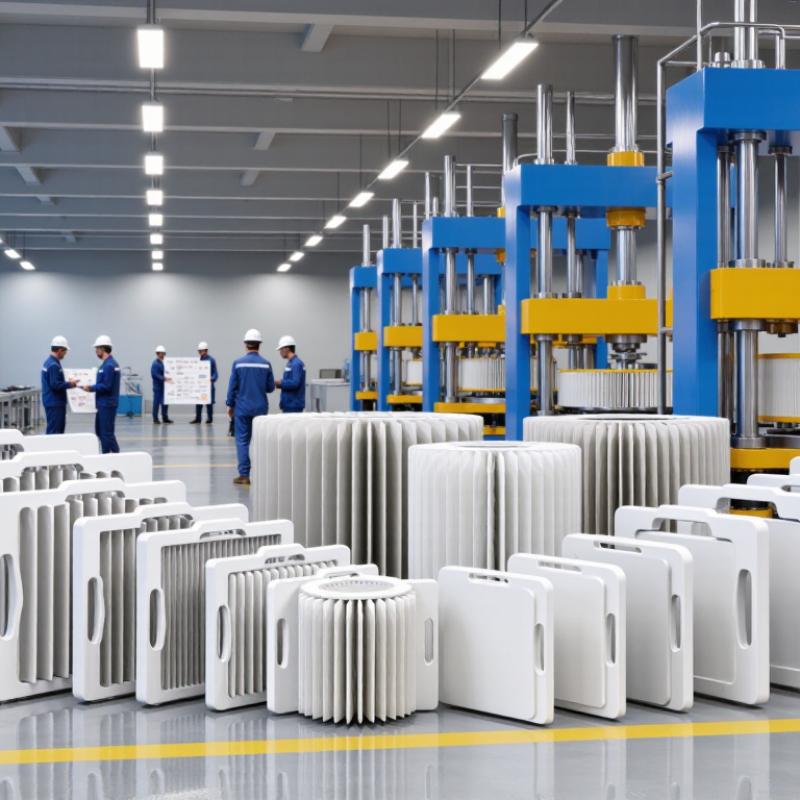
China Top 10 Chamber Filter Plate Manufacturers?

What Are Chamber Filter Plates and How Do They Work?

A chamber filter plate is a thick, recessed plate used in a filter press. Several plates clamp together, creating enclosed chambers lined with filter cloth. A pump pushes slurry into these chambers. Liquid passes through the cloth and internal channels, while suspended solids remain behind as a filter cake.

The principle is simple, but operation needs control. As cake builds, resistance increases and filtrate flow decreases. Typical recessed-chamber presses operate around 7–15 bar, depending on plate design and material compatibility. Polypropylene plates are common because they resist corrosion and remain relatively light. Temperature, particle size, cloth weave, and slurry chemistry still matter more than many buyers expect.

Industrial demand supports this equipment choice. Grand View Research estimated the global industrial filtration market at about USD 32.36 billion in 2023, with projected growth through 2030. That figure covers many filtration technologies, not chamber plates alone. It still shows why reliable solid-liquid separation remains commercially important.

A practical warning: a clean laboratory cake may look uniform, but production cakes often are not. Uneven feeding, worn cloths, or poor plate alignment can leave wet pockets. Operators should check filtrate clarity, cake moisture, pressure behavior, and cloth condition together. One reading is rarely enough. The best plate selection balances throughput, cleaning effort, chemical resistance, and the actual slurry—not only the catalogue specification.

How China’s Chamber Filter Plate Manufacturing Industry Is Structured

China Top 10 Chamber Filter Plate Manufacturers?

China’s chamber filter plate industry is structured around specialized production clusters, material suppliers, and application-specific integrators. Manufacturers commonly serve mining, food processing, chemicals, pharmaceuticals, and municipal wastewater projects. China’s National Bureau of Statistics reported that industrial wastewater treatment remained a major equipment demand area in 2023, supported by stricter resource-efficiency targets. The market is practical, not glamorous.

Production usually begins with polypropylene compounds, molds, membranes, handles, and sealing components. Injection molding creates the plate body, while CNC finishing improves feed holes and drainage surfaces. Larger suppliers often combine plate production with filter presses, cloths, pumps, and after-sales service. Smaller factories may focus only on molded plates or replacement parts.

Quality differences can be difficult to see. They appear during repeated pressure cycles, thermal changes, and abrasive slurry filtration. ASTM and ISO-based testing practices are often referenced, although implementation is not uniform across the sector. A 2024 report from Grand View Research valued the global industrial filtration market at over US$30 billion, indicating strong demand for reliable separation equipment. China’s manufacturing scale supports competitive pricing, but low-cost procurement can hide inconsistent polymer grades or weak weld lines. That requires inspection.

A serious supplier evaluation should check plate flatness, compression performance, chemical resistance, and documented batch traceability. Buyers should also review test records, mold maintenance, delivery history, and field references. Public ranking data remains limited. Therefore, any “top 10” list should combine production capability, engineering experience, export compliance, and verified customer performance rather than factory size alone.

China Top 10 Chamber Filter Plate Manufacturers? - How China’s Chamber Filter Plate Manufacturing Industry Is Structured

No. Anonymous Manufacturer Profile Typical Product Focus Common Plate Size Range Typical Plate Material Typical Filtration Pressure Primary Application Areas Market Role in China
1 Large-scale standard equipment manufacturer Standard recessed chamber plates and complete filter presses 800 × 800 mm to 2000 × 2000 mm Polypropylene, often with reinforced support structure Approximately 0.6–1.6 MPa, depending on design Municipal sludge, mining, chemicals, minerals High-volume domestic projects and export equipment
2 Custom engineering-focused manufacturer Non-standard plates designed for specific chamber volumes 400 × 400 mm to 1500 × 1500 mm Molded polypropylene and application-specific compounds Usually 0.6–1.2 MPa Food processing, pharmaceutical materials, fine chemicals Small and medium batches with application customization
3 Mining and mineral-processing specialist Heavy-duty plates for abrasive slurry filtration 1000 × 1000 mm to 2000 × 2000 mm Wear-resistant polypropylene with thickened sealing areas Approximately 0.8–1.6 MPa Coal, iron ore, non-ferrous minerals, tailings Durability-oriented supply for demanding slurry conditions
4 Municipal and environmental equipment supplier Plates optimized for sludge dewatering and stable cake release 800 × 800 mm to 1500 × 1500 mm Polypropylene with recessed chambers and replaceable seals Commonly 0.6–1.0 MPa Wastewater treatment, sludge dewatering, industrial effluent Project-based supply linked to environmental contractors
5 Chemical-process filtration specialist Corrosion-conscious plates for chemical slurry separation 630 × 630 mm to 1500 × 1500 mm Chemical-resistant polypropylene; special materials selected by medium Approximately 0.6–1.2 MPa Pigments, dyes, inorganic chemicals, battery materials Specification-driven supply with material compatibility checks
6 Food and beverage process supplier Hygienic chamber plates for liquid-solid separation 400 × 400 mm to 1200 × 1200 mm Food-contact-grade polypropylene where required Generally 0.4–0.8 MPa Starch, edible oils, fermentation, beverage ingredients Hygiene, cleanability, and traceability-oriented production
7 Replacement-parts and aftermarket manufacturer Replacement chamber plates, handles, seals, and feed components 400 × 400 mm to 2000 × 2000 mm Polypropylene matched to existing press specifications Based on the original filter press rating Maintenance, retrofit, emergency replacement, plant upgrades Short lead times and compatibility with installed equipment
8 Export-oriented component manufacturer Standardized plates prepared for international equipment integration 630 × 630 mm to 2000 × 2000 mm Molded polypropylene with configurable port arrangements Approximately 0.6–1.6 MPa Overseas water treatment, mining, chemical, and process plants OEM, contract manufacturing, and replacement exports
9 Small-batch regional fabricator Common-size plates and locally serviced filter-press parts 400 × 400 mm to 1000 × 1000 mm Standard polypropylene grades Usually 0.4–0.8 MPa Local wastewater, ceramics, food, and small industrial plants Price-sensitive orders and rapid regional delivery
10 Integrated filtration-system manufacturer Chamber plates supplied with presses, pumps, cloths, and automation 630 × 630 mm to 2000 × 2000 mm Polypropylene selected according to slurry and temperature Approximately 0.6–1.6 MPa Mining, municipal treatment, chemicals, food, and pharmaceutical processing Turnkey projects and integrated filtration-line delivery

Note: The table presents anonymized manufacturer profiles and commonly used industry specifications rather than named companies or a verified company ranking. Actual plate dimensions, pressure ratings, materials, and operating temperatures must be confirmed against the filter-press design and process medium.

China’s Top 10 Chamber Filter Plate Manufacturers

China’s Top 10 Chamber Filter Plate Manufacturers

China’s chamber filter plate sector serves wastewater, mining, chemicals, food processing, and metallurgy. Grand View Research estimated the global filter press market at about USD 1.1 billion in 2023. Its outlook also indicates steady growth through 2030. China remains a major manufacturing base, supported by broad industrial demand and mature polymer-processing capabilities. The strongest ten manufacturers should be judged by plate quality, not factory size alone. Thickness consistency matters. So does sealing performance.

China’s 2024 statistical data reported municipal wastewater treatment capacity above 200 million cubic metres daily. That scale creates sustained demand for durable chamber plates and replacement sets. Leading suppliers typically offer polypropylene plates, recessed chambers, reinforced handles, and compatible cloth-support surfaces.

Buyers should verify pressure ratings operating temperatures plate dimensions and actual cycle records. A catalogue is not enough. Field testing is better.

Independent industry research repeatedly highlights wastewater treatment and sludge dewatering as major filter press applications. However, ranking China’s top ten manufacturers is not perfectly objective. Public data rarely compare failure rates, delivery accuracy, and long-term service quality.

This is the weak point. A practical evaluation should examine factory audits, material certificates, sample testing, and customer references. Some suppliers look impressive online but provide limited technical evidence. Careful buyers should ask difficult questions before selecting a manufacturer.

How to Compare Chamber Filter Plate Manufacturers in China

How to Compare Chamber Filter Plate Manufacturers in China

Choosing a chamber filter plate manufacturer requires more than comparing quoted prices. During factory evaluations, inspect plate flatness, polypropylene grade, sealing edges, and drainage channels. A slight warp can leave a wet cake and increase cycle time. Grand View Research valued the global industrial filtration market at about USD 32.7 billion in 2023. It also projects continued growth through 2030. More competition does not always mean better quality.

Ask for measurable evidence. Request material certificates, dimensional inspection records, pressure-test results, and batch traceability. Compare filtration area, chamber volume, operating pressure, temperature range, and expected service cycles. ISO 9001 certification helps, but it does not prove plate performance. Independent laboratory testing is stronger. Check whether test conditions match your slurry. Clean-water testing can mislead. This detail is often overlooked.

Use a sample order before signing a large contract. Test the plates with your actual sludge, mineral pulp, or chemical suspension. Record cycle time, cake moisture, leakage, cloth fit, and cleaning effort. China Statistical Yearbook 2024 reported a 98.69% urban sewage treatment rate for 2023, reflecting sustained treatment demand. Still, market data cannot replace field validation. Compare response time, spare-part availability, mold maintenance, and complaint handling. Some suppliers provide excellent samples, but replacement plates may vary. Require written tolerances and acceptance criteria.

What Quality Standards and Applications Should Buyers Consider?

For buyers comparing China’s top 10 chamber filter plate manufacturers, quality begins with measurable evidence. ISO 9001 certification supports controlled production, but it does not prove plate performance. Request material certificates, dimensional records, pressure-test results, and batch traceability. Polypropylene plates should resist the chemicals, temperature, and pressure used in each process. A small mismatch can cause leakage, warped plates, or shortened service life.

Application data matters equally. The International Water Association reports that industrial water reuse is expanding as freshwater pressure increases. Filter plates therefore serve wastewater treatment, mining concentrates, chemical processing, food production, and pharmaceutical utilities. Each application needs different features. Mining may require abrasion resistance. Food processing needs cleanable surfaces and suitable contact materials. Chemical plants need verified compatibility, not general claims. Ask for cycle-life testing under realistic pressure, sludge thickness, and washing conditions.

The 2024 UNESCO World Water Development Report highlights growing competition for freshwater resources. This supports stronger demand for reliable solid-liquid separation equipment. Still, catalog specifications can look better than field results. Buyers should compare filtration area, cake release, moisture content, sealing performance, and replacement frequency. Independent laboratory reports add credibility. Factory audits add practical confidence. I would also inspect used plates, because brochures rarely show wear after thousands of cycles. No single certificate answers every question.

FAQS

Which industries commonly use chamber filter plates?

Common applications include mining, food processing, chemicals, pharmaceuticals, and municipal wastewater treatment. The equipment is practical, not glamorous.

How are chamber filter plates manufactured?

Production uses polypropylene compounds, molds, membranes, handles, and sealing components. Injection molding forms the plate body. CNC finishing improves feed holes and drainage surfaces.

Why can poor plate quality be difficult to notice?

Problems often appear after repeated pressure cycles, temperature changes, or abrasive slurry filtration. Weak weld lines may fail gradually. Inspection is necessary.

What should buyers inspect during a factory visit?

Check plate flatness, sealing edges, drainage channels, and polypropylene quality. Review mold maintenance and production records. Small warping can leave a wet filter cake.

Which documents should a supplier provide?

Request material certificates, dimensional inspection records, pressure-test results, and batch traceability. Certification helps, but it does not prove real plate performance.

How should buyers test sample plates?

Use the actual sludge, mineral pulp, or chemical suspension. Record cycle time, cake moisture, leakage, cloth fit, and cleaning effort. Clean-water testing can mislead.

Which technical specifications deserve comparison?

Compare filtration area, chamber volume, operating pressure, temperature range, and expected service cycles. Also check sealing performance and drainage design.

Does a larger manufacturer always provide better plates?

Not necessarily. Compare engineering experience, production capability, delivery history, and verified customer performance. Factory size alone proves little.

What after-sales details should buyers confirm?

Ask about response time, spare-part availability, mold maintenance, and complaint handling. Replacement plates may vary from approved samples. Require written tolerances and acceptance criteria.

What is the biggest purchasing mistake?

Choosing only by quoted price can hide inconsistent materials and weak production control. A sample may perform well, while later batches disappoint. This deserves reflection.

Conclusion

This guide explains what a Chamber Filter Plate is and how it supports solid-liquid separation in filter press systems. By creating enclosed chambers between adjacent plates, it helps retain filter cake while allowing clarified liquid to pass through filter cloth. The article also examines how China’s manufacturing industry is organized, including material suppliers, specialized producers, processing facilities, quality-control teams, and export-oriented distributors.

It presents a practical framework for evaluating China’s top 10 Chamber Filter Plate manufacturers without focusing on brand names. Buyers can compare suppliers by plate design, raw materials, dimensional accuracy, pressure resistance, production capacity, customization services, testing procedures, delivery reliability, and after-sales support. The guide also highlights important quality standards and application requirements across wastewater treatment, mining, chemical processing, food production, pharmaceuticals, and other industries. By matching technical specifications with operating conditions, purchasers can select durable, compatible, and cost-effective filtration equipment.

Madeline

Madeline

Madeline is a dedicated marketing professional with a wealth of expertise in our company's core offerings. With a keen understanding of the industry, she brings a unique perspective to her role, consistently delivering high-quality content that highlights the superior aspects of our products. As......